
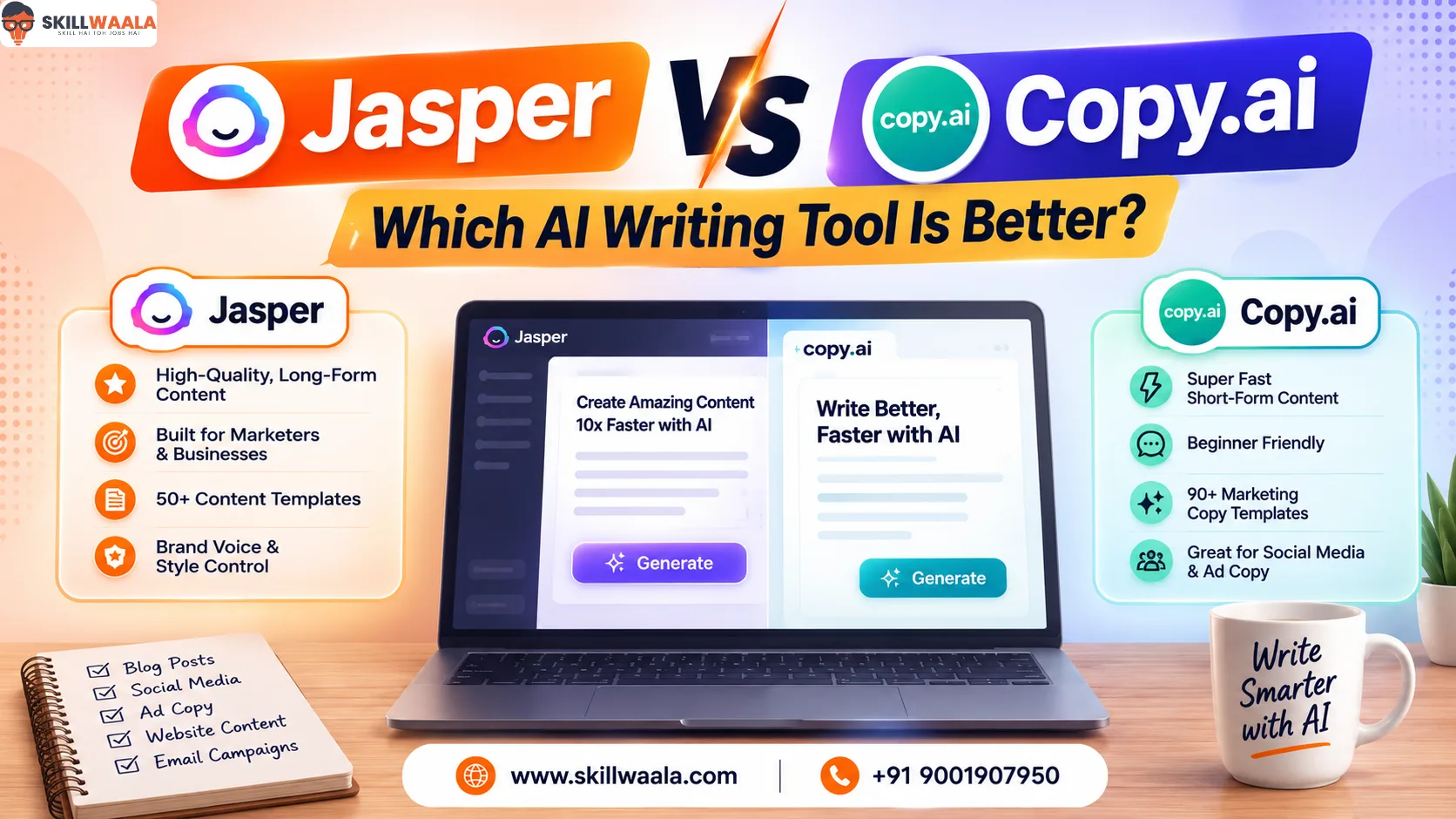
AI writing tools are no longer just fancy text generators. They can help you brainstorm ideas, create marketing copy, maintain a consistent brand voice, and speed up everyday content tasks. But choosing between two established names can get confusing.
That’s where the Jasper vs Copy.AI comparison gets interesting. Both are capable, but they approach AI-powered work quite differently. Jasper leans heavily towards marketing and brand-focused content, while Copy.ai has expanded into broader go-to-market workflows.
So which one deserves your time and money? Let’s compare them where it actually matters.
Jasper vs Copy.AI: Quick Comparison
If you want the short answer, Jasper is generally the stronger pick for structured marketing content and brand consistency, while Copy.ai makes more sense for broader sales and go-to-market workflows. Neither is automatically “better”; the right choice depends on what you actually plan to do with it.
| Factor | Jasper AI | Copy.ai |
|---|---|---|
| Best For | Marketing teams and content creation | Sales and GTM workflows |
| Ease of Use | Easy, but takes some learning | Relatively beginner-friendly |
| Brand Voice | Strong | Strong |
| Content Creation | Excellent for marketing use cases | Good, with broader workflow focus |
| Automation | Marketing-focused workflows | GTM-focused workflows |
| Ideal User | Marketers, creators, and teams | Sales, marketing, and GTM teams |
For someone primarily learning AI-assisted content creation, Jasper feels more purpose-built. Copy.ai becomes more interesting when your needs extend beyond writing into repeatable workflows.
What is Jasper AI?
Jasper AI is an AI-powered platform designed primarily for marketing and content creation. It helps users produce blogs, ad copy, emails, social media content, and other marketing assets while keeping messaging aligned with a defined brand voice.
Unlike a general-purpose AI chatbot, Jasper puts much more emphasis on repeatable marketing workflows and brand consistency. That makes it particularly useful for learning how AI can fit into professional content and marketing processes.
Where Jasper AI Excels?
Brand consistency: Jasper’s brand voice capabilities are one of its biggest strengths. You can provide information about your tone, style, and brand guidelines, helping the tool generate content that sounds more consistent across different formats.
Marketing-focused content: Jasper is built with marketers in mind. Blogs, landing pages, emails, social posts, and campaign copy feel like core use cases rather than add-ons.
Campaign creation: Instead of generating every asset separately, Jasper can help create multiple pieces of content around the same campaign. This becomes genuinely useful when you’re working across several channels
Easy to use: You don’t need deep technical knowledge to start using Jasper. Once you understand its features and workflows, creating and refining content is fairly straightforward.
Where Jasper AI Lacks?
The biggest issue highlighted in many Jasper AI reviews is value for casual users. Its marketing-focused features can be useful professionally, but they may feel excessive if you only need AI for occasional writing or experimentation.
Jasper-generated content also isn’t publish-ready by default. Factual claims still need verification, while repetitive phrasing, generic observations, and an overly polished AI tone can creep into longer pieces.
Another limitation of Jasper AI is that its specialized focus can work against it. If your needs extend far beyond marketing and content creation, a more general-purpose AI assistant may give you greater flexibility.
Confused between ChatGPT and Google Gemini? Explore our detailed comparison covering AI capabilities, reasoning, coding, content creation, image generation, integrations, pricing, and real-world use cases. Find out which AI chatbot is the better fit for your work, studies, or everyday productivity.
Read the ChatGPT vs Google Gemini Comparison →What is Copy.ai?
Copy.ai started as an AI copywriting tool, but it has since expanded well beyond generating blogs and social media captions. Today, the platform focuses heavily on go-to-market (GTM) AI, combining content generation with workflows for marketing, sales, and other revenue-focused tasks.
For someone exploring practical workplace applications of AI, that broader approach is appealing. You can use Copy.ai for everything from drafting content to researching prospects and automating repetitive GTM processes.
Where Copy.AI Excels?
GTM workflows: Copy.ai’s biggest differentiator is its workflow approach. It can support multi-step processes involving sales prospecting, content creation, account research, and lead-related tasks.
Beginner-friendly content creation: Despite becoming a broader platform, generating copy remains relatively straightforward. Blogs, emails, social posts, and marketing copy can be created without a steep learning curve.
Workflow automation: Repetitive tasks can be turned into reusable workflows. For professionals handling similar research or content tasks every week, this can save considerable time.
Wide range of use cases: A typical Copy.ai review focused only on writing misses part of the picture. The platform now stretches across marketing and sales, giving users more room to experiment with AI beyond content generation.
Where Copy.AI Lacks?
One of the main limitations of Copy.ai is that its broader focus can make the platform feel less specialized for pure content creation. If writing and brand-led marketing are your priorities, Jasper’s dedicated marketing ecosystem may feel more refined.
Output quality can also vary. Longer content often requires restructuring, fact-checking, and human editing before it feels natural enough to publish.
There’s also a learning curve once you move beyond basic prompting. Creating useful automated workflows requires understanding what each step should accomplish, so the platform’s more powerful features may not deliver immediate value to complete beginners.
Can’t decide between Midjourney and DALL·E? Explore our detailed comparison covering image quality, photorealism, prompt accuracy, artistic styles, ease of use, pricing, and real-world use cases. Whether you’re a designer, marketer, or content creator, this guide will help you choose the best AI image generator for your workflow. :contentReference[oaicite:0]{index=0}
Read the Midjourney vs DALL·E Comparison →Jasper vs Copy.AI: Key Differences
I don’t think Jasper vs Copy.AI comes down to which tool can write the better paragraph. Both can produce decent copy. The bigger difference is what happens once you move beyond a simple prompt.
Content Quality
For marketing content, I generally prefer Jasper. Give it enough context about the audience, brand, and purpose, and the output tends to feel more controlled. It’s particularly useful when you’re creating several pieces of content around the same campaign.
Copy.ai can write perfectly usable content too, but writing isn’t really its main advantage anymore. I’d choose it when content generation is only one part of a larger workflow.
Ease of Use
Both tools are fairly easy to start with. You can open either one, enter a prompt, and get something useful without spending hours watching tutorials. The complexity appears later.
Jasper takes some time to set up properly if you want to use Brand Voice and other marketing features.
Copy.ai gets more complicated once you start building GTM workflows. For basic writing, though, I wouldn’t consider either particularly difficult.
Brand Voice and Customization
This is one area where Jasper stands out more.
If I were producing content regularly for the same company. I’d rather spend time setting up Jasper with the right brand information than repeat the same instructions in every prompt.
Copy.ai also supports brand context, but Jasper feels more deliberate, built around keeping marketing content consistent.
Templates and Workflows
The Jasper AI vs Copy.ai difference becomes much clearer here.
Jasper’s workflows revolve largely around marketing: campaigns, content, messaging, and brand assets.
Copy.ai takes workflows further into GTM tasks. You might use a workflow to research accounts, prepare sales outreach, repurpose information, or automate a repetitive marketing process.
That makes my choice fairly simple: Jasper for a content-heavy marketing workflow; Copy.ai when the workflow extends into sales and GTM operations.
Integrations and Automation
Copy.ai has the edge if automation is the reason you’re considering these tools in the first place. Its workflow system is designed to connect multiple steps rather than simply generate a finished piece of copy.
Jasper’s automation capabilities make more sense within a marketing content creation operation. That narrower focus isn’t necessarily a weakness. If you spend most of your day creating campaigns and content, you may actually prefer it.
Jasper vs Copy.AI Pricing
Pricing changes how I look at this Jasper AI comparison quite a bit. Both tools are aimed increasingly at professional use, but Copy.ai gives individuals a noticeably cheaper entry point.
| Plan | Jasper AI | Copy.ai |
|---|---|---|
| Entry Paid Plan | Pro – $69/month | Chat – $29/month |
| Annual Billing | Pro – $59/month | Chat – $24/month |
| Higher Plans | Business – Custom Pricing | Growth – $1,000/month |
| Free Trial | 7 Days | Not Available |
Jasper’s Pro plan costs $69/month per seat, or $59 per month when billed annually. It includes Canvas, core marketing agents, two brand voices, five knowledge assets, and three audiences.
The Business plan uses custom pricing and adds features such as custom AI agents, Jasper Grid, API access, and more advanced brand customizations.
Copy.ai’s Chat plan is much cheaper at $29 per month, dropping to $24 per month when billed annually. Interestingly, it includes five seats and unlimited words in Chat.
The jump after that is huge: its Growth plan costs $1,000 per month and is clearly intended for businesses running AI workflows at scale.
For an individual paying out of their own pocket, I’d find Copy.ai easier to justify. Jasper starts getting expensive fairly quickly, especially once the USD price is converted to rupees and taxes are factored in.
That being said, I wouldn’t choose Copy.ai simply because it costs less. If I were using AI every day for brand content, campaigns, and marketing work, Jasper’s extra cost could make sense. If I were mainly experimenting, learning, or handling occasional writing tasks, $69 every month would be difficult to justify.
Grammarly or QuillBot: Which One Should You Choose?
Not sure whether to choose Grammarly or QuillBot? Our detailed comparison breaks down what each tool does best, from polishing grammar and tone to rewriting and paraphrasing content. See their key differences and choose the writing assistant that fits your workflow and budget.
See Which Writing Tool Is Better →Limitations of Jasper AI and Copy.AI
I wouldn’t subscribe to either tool expecting it to take over the entire writing process. Jasper and Copy.ai can save a lot of time, but both still need someone who knows what good content looks like. The weaknesses just show up in different places.
Limitations of Jasper AI
My biggest issue with Jasper is that you need to use its marketing features to really justify the price.
If all you do is open Jasper Chat and ask it to write blogs or emails, there are plenty of Jasper AI alternatives that can handle those tasks.
Jasper can also produce content that feels a little too clean and predictable. Brand Voice helps with consistency, but it doesn’t magically add genuine experience, opinions, or subject expertise. I’d still edit important content quite heavily before publishing it.
Limitations of Copy.AI
Copy.ai has almost the opposite problem. It has expanded so far into GTM automation that I wouldn’t necessarily recommend it to someone who simply wants a great writing assistant.
Its workflows are useful, but there’s a learning curve involved. You need to understand the process you’re trying to automate before the automation itself becomes valuable. Otherwise, you’re adding complexity to a task that might have taken five minutes manually.
I’ve also found this to be a useful rule with AI writing tools generally. The easier a piece of content is to generate, the more suspicious I am of publishing it without editing.
Copy.ai and Jasper can get you to a first draft much faster. However, neither removes the need for fact-checking, original examples, judgment, and a good edit.
Top 10 AI Writing Tools Comparison
Looking for the best AI writing assistant? Compare the Top 10 AI Writing Tools, including ChatGPT, Jasper AI, Copy.ai, Writesonic, Rytr, Grammarly, and more. Discover their features, pricing, strengths, and ideal use cases to choose the right tool for blogging, SEO, marketing, business, or creative writing.
Compare the Top 10 AI Writing Tools →Jasper vs Copy.AI: Which One Should You Choose?
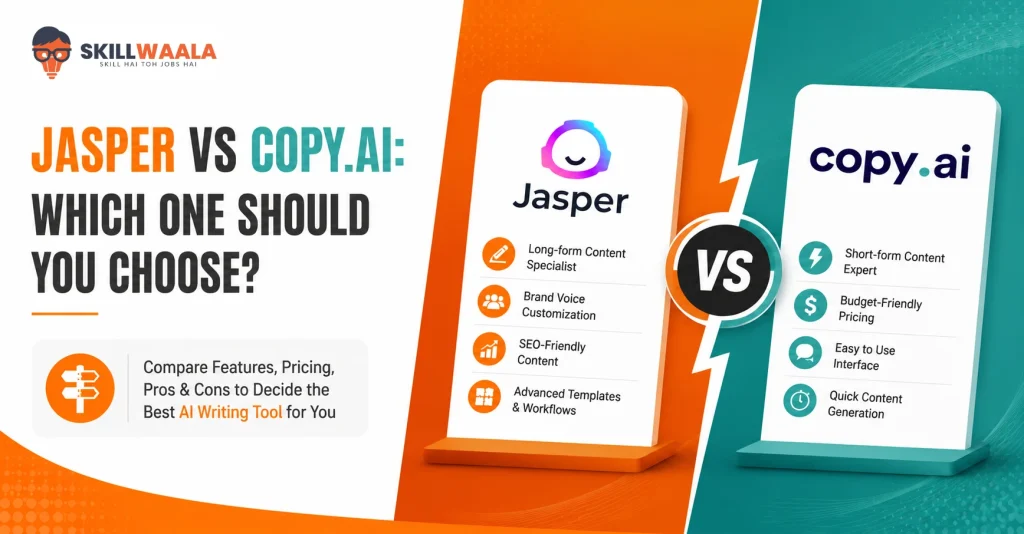
After comparing the two, I wouldn’t call either tool the universal winner. Jasper makes more sense when content and marketing are the centre of your workflow. Copy.ai becomes more interesting when you want AI to handle processes beyond writing.
When to Choose Jasper?
I’d pick Jasper if I were regularly creating blogs, landing pages, ads, emails, or complete marketing campaigns for the same brand. Its Brand Voice and marketing-focused tools become much more valuable when consistency matters across dozens of content pieces.
It’s also the one I’d lean towards for learning how AI fits into a professional content marketing workflow. You’re not just practising prompts; you’re learning how brand context, audiences, campaigns, and AI-generated content work together.
When to Choose Copy.AI?
Copy.ai would be my choice if I wanted to experiment with AI beyond content creation. Its GRM workflows make more sense for tasks involving sales outreach, account research, lead processing, and repeatable business processes.
The lower-priced Chat plan also makes Copy.ai easier to experiment with before committing serious money.
Jasper AI and Copy.ai Alternatives
I wouldn’t limit the decision to just Jasper and Copy.ai. AI tools overlap so much now that you may find another platform fits your workflow better. In fact, I regularly prefer combining specialized tools rather than expecting one subscription to handle everything. A few Jasper AI alternatives and Copy.ai alternatives worth considering are:
- ChatGPT: The one I’d consider first for general-purpose writing, research, brainstorming, analysis, and everyday AI tasks. It requires more prompting than a specialized marketing platform, but that flexibility is also its strength.
- Claude: It is particularly good when I’m working with long documents or want to develop and refine a piece of writing through multiple iterations.
- Writesonic: A closer alternative if your priorities include marketing content, SEO, and content creation rather than broader workplace tasks.
- Gemini: It is worth exploring if you already work extensively with Google’s ecosystem and want AI integrated into everyday productivity.
I wouldn’t switch simply because another tool has a longer feature list. Start with the task you repeat most often. If that’s creating branded marketing content, Jasper still has a strong case.
If it’s GTM automation, Copy.ai is more interesting. For general AI skills, though, I’d probably start with a versatile assistant before paying for either specialized platform.

Final Verdict
For pure marketing and content creation, I’d choose Jasper over Copy.ai. Its focus on brand voice, campaigns, and consistent marketing content gives it a clearer purpose. If those are the skills you want to develop, Jasper is easier to fit into a real content workflow.
Copy.ai wins for a different reason. I’d choose it when writing is only one part of the job and I also want to explore sales, prospecting, and GTM automation.
That’s really the Jasper vs Copy.ai decision in a nutshell.
- Jasper is the better marketing specialist
- Copy.ai is the broader GTM tool
Neither replaces good judgment, though. Learning how to guide, edit, fact-check, and improve AI output will ultimately matter more than which logo is on your subscription.
Frequently Asked Questions (FAQs)
For marketing content, I’d generally choose Jasper. Its Brand Voice, campaign tools, and marketing-focused features make it better suited to producing consistent content at scale. Copy.ai is the strongest choice when you want AI for broader GTM workflows involving sales, prospecting, and automation.
Yes, especially if you start with its basic chat and content-generation features. The learning curve gets steeper when you move into automated workflows. I’d learn the fundamentals first rather than trying to automate everything from day one.
Jasper can be worth paying for if you regularly create marketing content and actually use features such as brand voice, campaigns, and marketing agents. For occasional AI writing, I’d struggle to justify the subscription because cheaper and more flexible alternatives are available.
In my opinion, no. Both can handle brainstorming, first drafts, rewriting, and repetitive content tasks remarkably quickly. They still need human input for original experience, fact-checking, strategic decisions, nuanced opinions, and editing. I see them as tools that change a writer’s workflow rather than replacements for the writer.
I’d give Jasper the advantage for long-form marketing content. Its emphasis on brand context and marketing workflows makes it easier to keep content aligned with a particular audience and brand. That doesn’t mean I’d publish Jasper’s first draft untouched.
About The Author