
Nervous for your upcoming Meta Ads interview and unsure which Meta Ads interview questions might come your way? Don’t stress by assuming that the recruiter will ask something tricky or you’ll forget the metrics or terms. Meta Ads is a detailed system where both technical knowledge and strategy matter. Hence, a little pressure is natural, but don’t get anxious.
We’ve prepared a practical guide that’ll make you ready for the entire interview process. Here you’ll find commonly asked interview questions about Meta Ads that recruiters test at each level, from beginner to advanced. By the end, you’ll gain clarity on the logic behind the questions that recruiters ask and learn to frame confident answers.
Meta Ads Interview Roadmap: Topics Based on Experience
The type of Meta Ads interview questions recruiters ask usually depends on your experience level. Freshers are generally tested on fundamental concepts, while experienced professionals are expected to demonstrate practical knowledge, campaign optimization skills, and performance marketing strategies. The table below gives a quick overview of the topics commonly covered in Meta Ads interviews based on experience.
| Experience Level | Topics Asked |
|---|---|
| Fresher | Campaigns, objectives, audience targeting, ad formats, Meta Ads hierarchy, and Ads Manager basics |
| 1–3 Years Experience | Meta Pixel, conversion tracking, A/B testing, campaign optimization, audience creation, CTR, CPC, and ROAS basics |
| 3+ Years Experience | ROAS optimization, campaign scaling, attribution models, bidding strategies, troubleshooting, and performance analysis |
| Performance Marketer | Marketing funnel, retargeting, creative testing, budget scaling, conversion optimization, audience segmentation, and advanced campaign strategies |
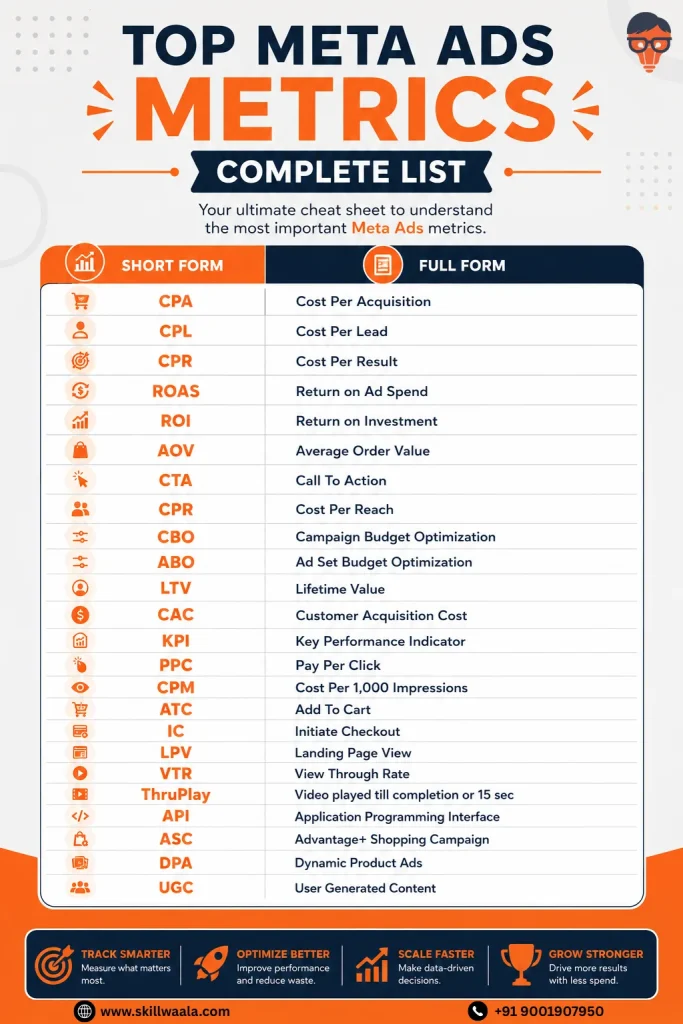
Critical Meta Ads Metrics That Interviewers Ask
It is important to understand meta ads metrics in order to crack interviews. It becomes even more important when it comes to performance marketing and paid ads roles. Recruiters may ask you about key performance indicators (KPIs) to test your practical understanding of campaign performance, optimization, and ROI.
Here are some of the most essential metrics of meta ads that every candidate should know before giving an interview.
| Metric | Full Form | Meaning / What It Measures |
|---|---|---|
| CTR | Click Through Rate | The rate at which users click an ad based on the number of impressions received. Helps evaluate ad relevance and engagement. |
| CPC | Cost Per Click | The amount spent for each click on your ad. Used to measure traffic cost efficiency. |
| CPM | Cost Per Mille | Cost per 1,000 impressions. Helps understand brand awareness campaign costs. |
| CPA | Cost Per Acquisition | Measures how much you spend to get one conversion, lead, or customer. |
| ROAS | Return on Ad Spend | Means how much revenue is generated for every ₹1 spent on ads. |
| Impressions | — | The total number of times your ad is viewed by users. |
| Reach | — | Number of unique users who viewed your ad. |
| Conversion Rate | — | The percentage of users who complete the desired action after clicking the ad. |
| Frequency | — | Shows how many times the same user saw your ad on average. |
| Engagement Rate | — | Measures interactions like likes, comments, shares, and saves on ads. |
| CPR | Cost Per Result | The average amount spent to achieve your selected campaign objective. |
| Landing Page Views | — | Number of users who actually loaded the landing page after clicking the ad. |
| Video Watch Time | — | Measures how long users watched your video ads. Important for video campaigns. |
| Add to Cart Rate | — | Tracks how many users added products to their cart after visiting the website. |
| Bounce Rate | — | Percentage of visitors who leave the landing page without taking any action. Helps identify landing page issues. |
Understanding these meta ads metrics helps in both interviews and a practical understanding of campaign performance, optimization, and ROI tracking.
Meta Ads Interview Questions for Beginners
Below, we’ve listed some of the most commonly asked Meta Ads questions for interview preparation, ideal for beginners:
1. What are Meta Ads and how do they work?
Meta Ads is a digital advertising platform where businesses promote their products and services across Meta platforms, like:
- Messenger
- Audience Network
This system works on an auction-based model, a core concept often discussed in Meta Ads-related interview questions, where each ad is given a score based on its bid amount, estimated action rate, and ad quality. Meta then gives preference to those ads that are most relevant to the users.
The objective of this process is to connect the right audience with the message and placement to efficiently achieve campaign goals, like:
- Awareness
- Engagement
- Conversions
2. What are the different ad formats available on Meta Ads?
The Meta Ads platform offers multiple ad formats designed for different marketing objectives, including:
- Images
- Videos
- Carousels
- Collections
- Canvas
All these formats can be used for better performance and results. Images are used to deliver clear messages using single visuals. Video ads are considered ideal for storytelling and engagement. Carousel displays multiple images and videos in a single ad, where each of them has a unique link. Collection ads are useful for e-commerce campaigns as they allow users to browse and purchase directly. Canvas provides an engaging, fast-loading experience to mobile users.
The right mix of these formats is chosen based on your campaign goals and how your audience behaves, which helps generate the best results.
3. Explain the three-level hierarchy followed by Meta Ads Manager?
Campaign, ad set, and ad are the three levels of the structured hierarchy that Meta Ads Manager follows. Each of them has a distinct role and objective.
Campaign
You specify your advertising objective at this level, and it serves as the foundation of a campaign. Your objective can be:
- Brand awareness
- Traffic
- Conversions
Ad Set
An Ad Set defines who will see your ad and how it will be shown to them. At this stage, you decide the:
- Target audience
- Budget
- Schedule
- Placement
- Bidding strategy
Ad
An ad is the visual and messaging element visible to the audience. This stage is to finalize the creative elements, like:
- Image
- Video
- Headline
- Primary text
- CTA
4. How does the Meta Ads algorithm decide which ads to show?
Meta Ads algorithm works on an auction-based system where each ad is evaluated based on the following three factors:
Bid Amount
It is the amount that advertisers are ready to pay for a specific result, like clicks or conversions.
Estimated Action Rate
The algorithm predicts the chances that users will take the desired action after seeing the ad.
Ad Quality
Meta assesses ad quality based on factors like:
- User feedback
- Engagement rate
- Negative signals.
The algorithm balances these three parameters and prefers the ad that provides a high-quality and relevant experience to the user.
5. What is the importance of setting a campaign objective?
The campaign objective is the most crucial element of Meta Ads because it defines the direction and optimization of the entire campaign.
The Meta system trains its algorithm according to each objective. For example, if you go with Traffic, it’ll show your ads to users who often click links. If you choose Conversions, it’ll focus on those who usually buy or sign up.
So, setting the right objective helps Meta spend your budget on the right audience and gives you results that actually match your business goals.
Intermediate Level Meta Ads Interview Questions
Now, let’s look at some interview questions about Meta Ads that are asked at the intermediate level, focusing on practical understanding and strategy.
6. How do you define and create a target audience for Meta Ads?
A commonly featured topic in Meta Ads interview questions, defining the target audience in Meta Ads is a data-based and insight-driven process where you can identify your ideal customers based on:
- Demographic
- Interest
- Behaviour
This setup is done at the Ad Set level, where you customize your audience according to your campaign objective.
Primarily, Meta provides three types of audiences:
- Core Audience
- Custom Audience
- Lookalike Audience
Core Audience
You manually create the core audience from scratch by setting filters such as location, age, gender, and language.
Custom Audience
These are the users who have already interacted with your business through your website, app, email, or social media.
Lookalike Audience
This refers to the group of people who share similar interests with your existing customers or audience.
With this structured targeting approach, you can ensure that your ad reaches the right audience and drives real conversions and engagement from them.
7. What is the Meta Pixel, and how to install it?
Meta Pixel is a JavaScript tracking code that you put on your website to record the actions of website visitors, like:
- Page visits
- Purchases
- Sign-ups.
This helps advertisers to:
- Measure performance
- Track conversions
- Build a relevant audience for retargeting
It is the core component of Meta Ads optimization that enables data-driven targeting and reporting.
You can follow these steps to install Meta Pixel:
STEP 1 – Go to Meta Events Manager
Log in to your Meta Ads Manager and open the Event Manager section, the dashboard to manage the tracking resources. Here, click on the ‘Connect Data Sources’ option and select ‘Web’.
STEP 2 – Create a Pixel
Choose Meta Pixel, then give an identifiable name and enter your website URL. This step uniquely associates the Pixel with your business, helping ensure accurate tracking and providing better performance insights for your campaigns.
STEP 3 – Add Pixel Code to Website
Meta will generate a JavaScript code snippet that is to be pasted in the ‘head’ section of the website. If you use CMS (like WordPress, Shopify, and Wix), then through their integrations, this setup becomes even more simplified.
STEP 4 – Set Up Events
The next step is to decide the actions that you want to track, whether it is:
- View content
- Add to cart
- Purchase or
- Lead form submit
You can use Meta’s Event Setup Tool to manually configure these events without any additional coding.
STEP 5 – Verify Installation
After installation, the final step is to open the Meta Pixel Helper Chrome extension or the Diagnostics tab in Events Manager to ensure that the Pixel is running smoothly. If any event isn’t being tracked, recheck the code placement and permissions.
Accurately installed, Pixel provides the data that makes it possible to optimize campaigns, a detail often checked in Meta Ads questions during interview rounds, and helps in building effective retargeting strategies.
Want to Learn Meta Ads Like a Pro?
Learn Meta Ads (Facebook & Instagram Ads) from scratch with SkillWaala’s free Meta Ads course. Master audience targeting, campaign setup, ad creatives, lead generation, and performance marketing with practical learning.
Enroll Now for Free Meta Ads Course8. Describe A/B Testing and its importance on Meta Ads?
A/B testing is a structured experimentation process in Meta Ads where two versions of an ad are run. Where only a single element differs between them, whether it be the headline, image, CTA, or audience targeting. The objective of A/B testing is to identify the variation that has better performance to make decisions based on data.
Importance of A/B Testing in Meta Ads:
- Enhances Performance Efficiency
It helps identify ad versions that generate the best ROI with lower CPC, higher CTR, or better conversion rate, to smartly utilize the ad budget.
- Understands Audience Behaviour
Every audience responds differently. Testing helps you understand which creative, tone, or offer engages a particular age group or segment the most.
- Improves Creative Quality
Even small adjustments, like changing a single line or image, can make a noticeable difference in campaign results. It’s a practical tool for continuous improvement.
- Minimizes Financial Risk
Advertisers can secure their ad spend and identify weak concepts by testing on a smaller scale before launching the full campaign.
- Sustains Long-Term Optimization
Audience trends and algorithms keep changing. Regular testing ensures that your ads remain updated, relevant, and competitive.
In short, A/B testing is the foundation of Meta Ads optimization; it maintains a balance between creativity and data, which helps campaigns perform consistently.
Also Read – Digital Marketing Interview Questions & Answers
9. How to measure and analyze the success of a Meta Ads campaign?
To measure the success of your Meta Ads Campaign, it’s important to understand your objective. There are different performance metrics for each goal, which is why your analysis should be based on your objectives, like:
- Awareness
- Traffic
- Engagement
- Conversions
Meta Ads Manager gives a detailed dashboard to evaluate your campaign performance, where you can track key metrics such as:
- Impressions
- Reach
- Clicks
- Click-Through-Rate(CTR)
- Conversions
- Return on Ad Spend (ROA)
For example, if your goal is brand awareness, then metrics related to reach and frequency will be relevant. However, if the focus of your campaign is sales and leads, then key metrics like conversion rate, cost per result, or ROAS should be tracked.

10. List some common issues that lead to ad disapproval and how you would fix them.
Disapproval of ads is a common challenge faced by marketers in Meta Ads. Even a small mistake can cause your ad to get rejected because the platform reviews every ad in detail through both automated and manual checks. The reasons for disapproval can be:
- Policy violations
- Misleading content
- Poor user experience
Apart from these, some common causes of disapproval are:
- Restricted use of keywords
- Exaggerated claims
- Low-quality visuals
- Mismatched landing page
- Indirect reference to a sensitive topic
- Excessive text on images
Let’s have a look at how you can fix these issues that lead to ad disapproval:
- Review Meta’s Advertising Policies
- Make policy-compliant ad copy and creatives
- Ensure realistic and verifiable claims
- Maintain fast-loading and relevant landing pages
Once your ad is rejected, you can correct the issue and appeal through the Review Request option.
Through consistent monitoring and A/B testing, you can avoid future rejections and improve overall ad quality score.
Advanced Level Meta Ads Interview Questions
Now, let’s look at some of the most frequently asked advanced-level Meta Ads interview questions along with their answers.
11. How can I optimize ad creatives for engagement and conversion?
The main purpose of optimizing ad creatives is to make your message visible, actionable, and engaging. Effective optimization is when you use both creativity and data together.
The following steps will help you optimize ad creatives for better engagement and conversion:
Start with understanding your audience
The optimization process starts with your audience. Firstly, you should understand the type of content that your audience prefers. Studying audience insights and old campaign data on Meta helps you choose the right creative approach.
Test multiple versions before scaling
Creative testing is an important step where you make several versions of an ad, each with different:
- Headlines
- Visuals
- CTA
With A/B testing, you can find the better-performing version generating more engagement and conversions, and then spend your money and effort on what works best.
Keep a balance between visuals and text
An effective ad creative should be:
- Visually clean
- Brand-aligned
- Mobile-friendly
Your messages should be short, actionable, and not overly sales-driven. When your images and text work together, your ad feels more genuine and relatable.
Use storytelling to build an emotional connection
Audience engages with your ad only till they find your ad relevant. You can build an emotional connection between your brand and consumers by using:
- Short videos
- Lifestyle imagery
- Testimonials
This enhances both trust and recall, which increases the chance of conversion.
Keep checking, learning, and improving.
Optimization is an ongoing process. Keep reviewing your campaign data to find best best-performing and underperforming creatives. After that, boost the strong creatives and update or replace the weak ones.
In short, creative optimization is a continuous process that helps improve Meta Ads performance by watching, testing, and adjusting.
12. How to create a Lookalike Audience and when to use it.
A lookalike audience helps you find new people who are similar to your existing customers. It helps you connect with more people while keeping good conversion results.
Follow this process to create a lookalike audience:
Choose a reliable source audience
The process starts with selecting a strong source audience, such as:
- Website visitors
- Past purchasers
- Engaged followers
The performance of the lookalike audience depends on the accuracy and quality of the source audience.
Use Meta’s lookalike audience tool
Go to the audience section in the Meta Ads Manager and select the ‘Create Lookalike Audience’ option. Here, you choose your source audience on the basis of which Meta identifies similar users across its platforms.
Define location and audience size
The next step is defining the location and audience size. Choose the country or region where you want Meta to find your new audience. Then, set the audience size based on your goal. A smaller size (like 1%) finds people most similar to your existing customers, while a larger size (like 5–10%) gives you more reach but less accuracy.
When to use lookalike audiences
Lookalike audiences are best when you want to scale outside of your existing performing audience, like for:
- New customer acquisition campaigns
- Product launches
- Generating leads
It helps your ads reach people who are more likely to become customers.
In short, lookalike audiences help you reach more people while keeping your ads relevant. It’s a smart Meta Ads feature that gives advertisers both better results and wider reach.
13. How do you adjust bidding strategies for different campaign goals?
In Meta Ads, bidding strategies are tailored according to the campaign objective( a concept often explored in interview questions about Meta Ads) because each goal has a different intent. An awareness campaign is focused on reach maximization, while conversion-focused campaigns concentrate on ROI.
Here’s how you choose and adjust bidding strategies in Meta Ads according to different campaign objectives:
Awareness Campaigns: Focus on reach and impressions
If your goal is to increase brand visibility, then the lowest cost bidding or CPM (Cost Per 1000 Impressions) is the best strategy to follow. In this approach, you allow Meta to reach the maximum people with minimum cost.
Traffic Campaigns: Drive clicks to website
CPC (Cost Per Click) or Lowest Cost with Bid Cap strategy are effective for increasing website traffic. Here, you can manually set a bid limit to keep costs under control and ensure consistent ad performance.
Engagement Campaigns: Encourage interaction
If you want people to engage with your content through likes, shares, or comments, then you should use optimized post engagement bidding. Meta algorithm automatically reaches the audience that frequently interacts with similar content.
Conversion Campaigns: Focus on sales or leads
Cost Per Action (CPA) and Value Optimization bidding are best for conversion-oriented campaigns. This strategy encourages Meta to target users with the highest chances of purchase or lead, even if the cost per click is a bit high.
Retargeting or High-Value Campaigns — Control with manual bidding
When you are aware that the audience is limited and you need high-value conversions, then you should use manual bidding. This gives you direct control over ad delivery and allows you to maintain a specific bid range.
In short, aligning your bidding strategy with each campaign goal is essential. It assists you in ensuring ad spend optimization and efficiently achieving campaign objectives, whether it is awareness, engagement, or conversions.
Also Read – Advanced Seo Interview Questions and Answers
14. How do you stay updated with the latest algorithm and policy changes in Meta Ads?
Staying updated with Meta Ads’ ever-evolving ecosystem is crucial, and it’s one of the most common Meta Ads-related interview questions asked to assess how adaptive you are to platform updates.
Since the platform frequently introduces new features, algorithm updates, and ad policy changes, staying informed requires a structured approach. Here are some tips to stay updated with the latest algorithm and policy changes in Meta Ads:
Follow official Meta channels
Regularly follow and check notifications from the following for authentic updates directly from the source:
- Meta’s business help center
- Meta for business blog
- Ads manager
Subscribe to credible marketing newsletters
Numerous platforms provide insights, case studies, and trend analyses to decode complex updates into actionable strategies:
- Social media examiner
- AdEspresso
- HubSpot
Participate in professional communities
Join groups on Facebook, LinkedIn, or Reddit where marketers discuss real-time changes, share experiences, and highlight practical solutions.
Attend webinars and training sessions
Meta’s Blueprint webinars and industry workshops often feature experts explaining how to adapt to:
- New ad formats
- Bidding methods
- Compliance requirements.
Learning through experimentation
The best way to understand updates is by testing them in Ads Manager, running small-scale experiments to see how algorithm or delivery changes affect campaign results.
This consistent mix of learning, networking, and hands-on testing ensures your Meta strategies stay relevant, compliant, and effective.
15. Describe a challenging Meta Ads campaign you handled and how you overcame it.
Once, I managed a campaign for an e-commerce brand where the biggest challenge was that the CTR on ads was good, but conversions were very low. Their ad spend was increasing, but they were unable to achieve the desired ROI.
Firstly, I conducted a detailed audit of the campaign and realised that the targeting was very broad and the creatives didn’t match the website’s offers. Then, to address this issue, I used custom and lookalike audiences to reach high-intent users. Additionally, I renewed the creatives and focused on product benefits and customer trust elements.
In two weeks, there were noticeable results as the conversion rate improved to 40% and the cost per purchase reduced significantly. This experience taught me that success in Meta Ads can only be achieved when the following elements are perfectly synchronized:
- Data analysis
- Audience strategy
- Creative alignment
Scenario-Based Meta Ads Interview Questions
Here are some meta ads interview questions that are based on different scenarios. These questions are often asked in interviews. Let’s dig in.
Q1. Your Meta ad is getting good clicks, but conversions are very low. What would you do?
Ans. A high click volume with low conversions usually indicates an issue after the user lands on the website. I would review the landing page experience, check audience relevance, verify Pixel tracking, analyze offer-message consistency, and identify drop-off points in the checkout or lead form process. Based on the findings, I would optimize creatives, targeting, and conversion paths.
Q2. Your Meta Ads campaign is spending money but generating no leads. How would you fix it?
Ans. If the campaign is spending without generating leads, I would first verify that the lead form or landing page is working correctly. Next, I would review audience targeting, ad relevance, bidding strategy, and conversion tracking setup. I would also test new creatives, improve the offer, and analyze user behavior to identify and remove conversion barriers.
Q3. What could be the reason for high CTR and low ROAS?
Ans. A high CTR with low ROAS suggests that people are interested enough to click but are not completing purchases. This may be caused by poor audience quality, weak landing pages, pricing issues, slow website performance, or an offer that does not match the ad message. I would analyze conversion data and optimize the full sales funnel.
Q4. If a Meta ad gets disapproved repeatedly, what steps would you take?
Ans. If an ad is repeatedly disapproved, I would carefully review Meta’s advertising policies and identify the exact violation. I would check the ad copy, creatives, landing page content, and targeting settings for compliance issues. After making the necessary changes, I would resubmit the ad and contact Meta support if further clarification is required.
Q5. Your campaign CPC is suddenly increasing. How would you reduce it?
Ans. If CPC increases suddenly, I would first analyze audience saturation, ad relevance score, competition, and campaign performance trends. I would refresh creatives to reduce ad fatigue, test new audience segments, optimize placements, and review bidding strategies. Improving engagement rates and ad quality can help lower CPC while maintaining campaign performance and reach.
Beginner vs Advanced Meta Ads Skills: What Recruiters Expect from a Candidate
The level of Meta Ads interview questions often depends on your experience and practical experience with Meta Ads and campaigns. Freshers are usually asked basic questions on foundational concepts. Experienced candidates are expected to demonstrate advanced optimization, scaling, and troubleshooting skills.
Below is the table that gives a quick comparison of what recruiters generally expect at beginner, intermediate, and advanced levels. Understand this table so you learn what questions can be asked to you.
| Beginner | Intermediate | Advanced |
|---|---|---|
| Campaign objectives and ad goals | Meta Pixel setup and event tracking | Campaign scaling strategies |
| Different Meta ad formats | A/B testing and optimization | Attribution models and tracking |
| Audience targeting basics | Retargeting and remarketing | Budget optimization at scale |
| Campaign, Ad Set, and Ad hierarchy | Campaign performance metrics | Conversion troubleshooting |
| Ads Manager basics | Audience creation and segmentation | ROAS improvement strategies |
| Basic KPIs like Reach & CTR | CPC, CPM, CPA analysis | Advanced bidding strategies |
| Understanding placements | Creative testing | Funnel optimization |
| Basic campaign setup | Lead generation optimization | High-budget campaign management |
Top Interview Tips to Crack Meta Ads Job
To land a meta ads job, you require more practical knowledge than just having theoretical knowledge. Be it a fresher or an experienced marketer, both require the right preparation strategy so there can be higher chances of selection.
1. Understand Meta Ads Fundamentals Clearly
You must understand the basics of Meta Ads, including campaign objectives, ad formats, audience targeting, placements, and Ads Manager hierarchy. Most recruiters begin interviews with foundational questions before moving to advanced topics.
2. Learn Important Metrics and KPIs
You should be comfortable explaining key Meta Ads metrics such as CTR, CPC, CPM, CPA, ROAS, conversion rate, and frequency. Interviewers may ask how you analyze campaign performance and optimize weak metrics.
3. Prepare Practical Campaign Examples
If you have previously worked on Meta Ads campaigns, then prepare real examples of your campaigns. If asked, you must be able to explain your campaign goal, targeting strategy, budget, optimization process, and final results.
4. Practice Scenario-Based Questions
Many recruiters ask practical questions to test your problem-solving ability. For example, you may be asked how you would improve low conversions, reduce CPC, or troubleshoot an underperforming campaign.
5. Understand Meta Pixel and Conversion Tracking
Meta Pixel setup and event tracking are commonly asked topics, especially for candidates applying for performance marketing roles. Learn how Pixel works, event setup, retargeting, and conversion tracking basics.
6. Stay Updated with Meta Ads Trends
Meta Ads algorithms, ad formats, and policies change frequently. You must stay up to date with the latest Meta Ads updates, AI-based targeting features, Advantage+ campaigns, and privacy changes to demonstrate industry awareness.
7. Focus on Communication and Confidence
During the interview, recruiters also assess your confidence in how you explain the concepts. Try to answer questions in a structured way and explain your logic behind campaign decisions.
By combining practical knowledge, campaign understanding, and confidence, you can perform better in your Meta Ads interview and improve your chances of landing the job.

Conclusion
If you are appearing for a Meta Ads interview, you should have a thorough understanding of the platform, its features, and strategies. You can take help from these 15 Meta Ads interview questions and practice your response to confidently perform in your interview. All these beginner to advanced interview questions about Meta Ads and their answers will help you succeed in your upcoming Meta interview confidently.
Frequently Asked Questions(FAQs)
Meta Ads interview questions typically cover campaign objectives, audience targeting, ad formats, bidding strategies, Meta Pixel, conversion tracking, A/B testing, and performance metrics. Interviewers may also ask scenario-based questions about improving CTR, lowering CPC, increasing ROAS, handling ad disapprovals, and optimizing underperforming campaigns.
Meta Ads is relatively easy to learn for beginners because of its user-friendly interface and extensive learning resources. However, mastering audience targeting, conversion tracking, budget optimization, and campaign scaling requires hands-on experience. With regular practice and real campaign analysis, most people can develop strong Meta Ads skills.
Key Meta Ads metrics include CTR (Click-Through Rate), CPC (Cost Per Click), CPM (Cost Per Thousand Impressions), CPA (Cost Per Acquisition), ROAS (Return on Ad Spend), conversion rate, frequency, reach, and engagement rate. Understanding how these metrics impact campaign performance is essential for interview success.
To prepare for a Meta Ads interview, learn campaign objectives, audience targeting methods, Meta Pixel implementation, ad formats, bidding strategies, and reporting metrics. Practice analyzing campaign data and solving real-world scenarios. Reviewing case studies and explaining optimization strategies clearly can significantly improve interview performance.
The salary of a Meta Ads specialist in India depends on experience, industry, and location. Freshers typically earn between ₹3-6 LPA, while experienced professionals can earn ₹8-15 LPA or more. Specialists with expertise in lead generation, eCommerce, and performance marketing often command higher salaries.
Meta Pixel is a tracking code placed on a website to measure user actions such as purchases, sign-ups, and page views. It helps advertisers track conversions, build remarketing audiences, and optimize campaigns based on real user behavior, improving ad performance and return on investment.
A Meta Ads professional should understand audience targeting, campaign management, budget optimization, conversion tracking, Meta Pixel setup, analytics, and performance reporting. Strong analytical thinking, creative testing, communication skills, and knowledge of marketing funnels are also valuable for managing successful advertising campaigns.
Yes, Meta Ads remains a strong career option in 2026 as businesses continue investing in digital advertising across Facebook, Instagram, and related platforms. Skilled professionals who can generate leads, increase sales, and optimize advertising budgets are expected to remain in high demand across industries.
Meta Ads targets users based on interests, demographics, and behavior, making it effective for demand generation and brand awareness. Google Ads targets users based on search intent and keywords, making it ideal for capturing demand. Many businesses use both platforms to achieve better marketing results.
Yes, freshers can get a Meta Ads job by learning campaign setup, audience targeting, Meta Pixel, and advertising metrics. Completing certifications, running practice campaigns, building case studies, and demonstrating analytical skills can improve job opportunities, even without prior professional experience.
About The Author