
For the last year, digital marketing circles have sounded like a science fiction convention.
“AI SEO hacks.”
“GEO optimization.”
“LLM ranking frameworks.”
“Prompt-first content strategy.”
Meanwhile, Google quietly released documentation that said something surprisingly ordinary: build useful websites, create trustworthy content, and make pages accessible for machines and humans. That is it.
After spending more than 14 years working on SEO campaigns across local businesses, SaaS brands, affiliate websites, and ecommerce stores, we can say this confidently: most websites do not have an AI SEO problem. They have a fundamental problem. The irony is painful.
People obsess over AI visibility while their websites still have weak content, messy structures,
poor internal linking, and generic articles written like school assignments. Google’s latest guidance around AI search and optimization confirms what experienced marketers already suspected. Traditional SEO is not dead. It just became harder to fake.
Google’s AI Search Documentation Changed the Conversation
Recent documentation from Google and industry discussions made one thing clear:
AI optimization is not a separate discipline. Google repeatedly emphasized:
- Helpful content
- Strong technical SEO
- Clear page structure
- Crawlable websites
- Real expertise
- User focused experiences
Notice what is missing?
- No secret AI tags.
- No magical prompt formatting.
- No weird “LLM stuffing” tactics.
A lot of agencies built services around these ideas anyway. Some even started selling expensive “AI ranking systems” without understanding how search engines actually process information. Google pretty much shut that down.
The Biggest SEO Mistake Right Now
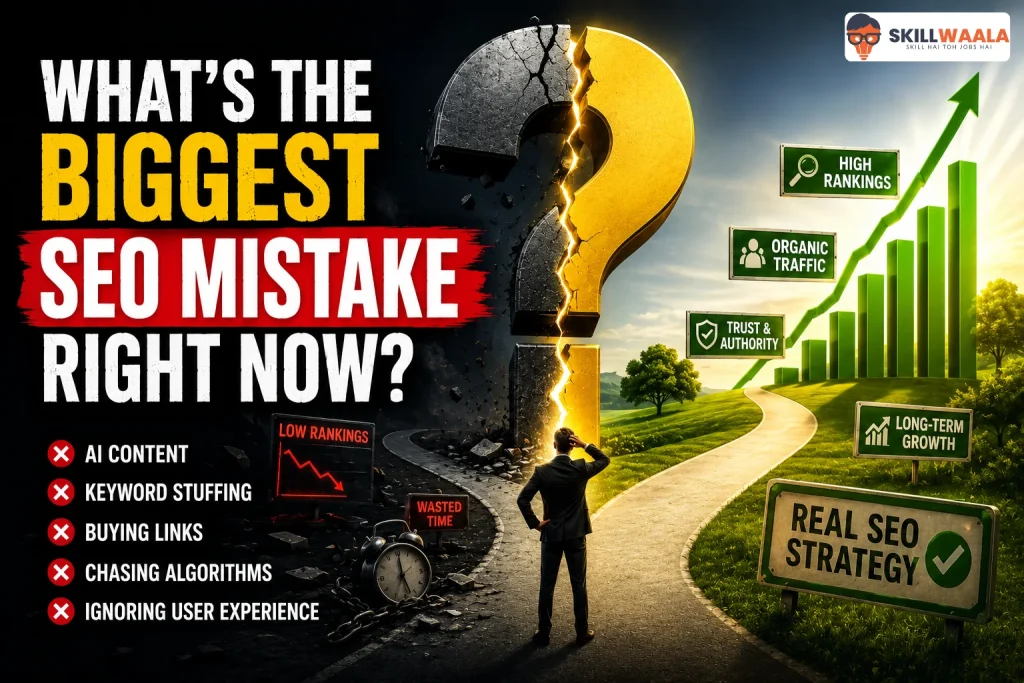
Many marketers are producing AI-generated content at an industrial scale. Fifty blogs a week, hundreds of rewritten pages, and zero original thinking.
Traffic spikes sometimes happen in the beginning. Then rankings disappear three months later, and nobody knows why. Actually, they do know why, and the content is forgettable.
Search engines are getting better at identifying pages that offer no unique value. AI-generated content is not the issue by itself. Thin, repetitive, low-effort content is the real problem.
We recently audited a website that published nearly 400 AI-written articles in six months. Impressive publishing speed. Terrible engagement metrics.
Average session duration was under 40 seconds.
Users were landing on the page and leaving almost immediately because every article sounded like recycled internet soup.
Meanwhile, a smaller competitor publishing only four detailed articles monthly kept growing steadily because its content included:
- Real screenshots
- Original opinions
- Practical walkthroughs
- Personal experience
- Updated statistics
Search engines noticed the difference.
Users noticed it first.
Traditional SEO Still Controls Visibility
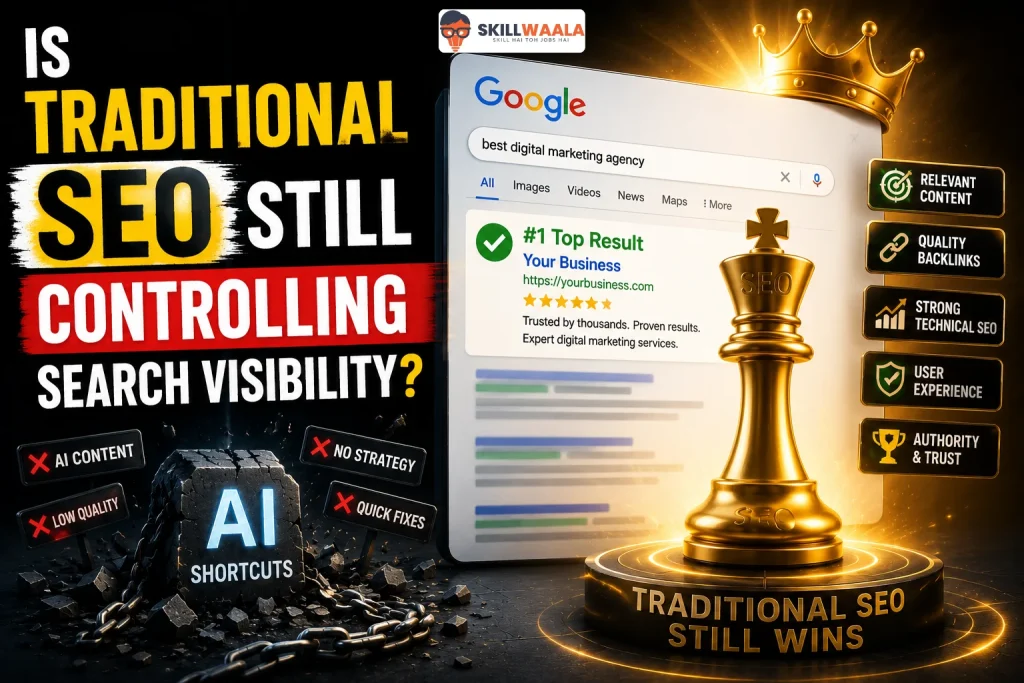
The fundamentals continue to drive rankings, even inside AI-powered search experiences.
Helpful Content Matters More Than Ever
Google’s systems still prioritize content that solves problems clearly and not robotic filler.
Not keyword spam disguised as “optimization.”
Useful content usually contains:
- Clear explanations
- Real examples
- Firsthand experience
- Accurate information
- Logical formatting
One strong article can outperform twenty weak AI-generated pages. We have watched this happen repeatedly across competitive industries.
Technical SEO Is Quietly Becoming More Important
AI systems still rely on structure.
That means search engines need to:
- Crawl your pages
- Understand page hierarchy
- Extract key information
- Interpret relationships between topics
Messy websites create confusion for both users and AI systems. Simple improvements often create massive gains:
Technical fixes worth prioritizing:
- Improve page speed
- Fix broken internal links
- Use proper heading structures
- Clean up mobile usability
- Add schema where relevant
- Reduce cluttered navigation
Most businesses ignore these basics because they are not exciting. SEO rarely rewards excitement.
Entity Building Beats Keyword Stuffing
Search engines increasingly evaluate brands, authors, and topical authority instead of isolated keywords. That shift changes the content strategy completely. Instead of publishing random blogs, strong websites build interconnected topic clusters.
For example, a digital marketing website should naturally cover:
- SEO fundamentals
- Link building
- Technical SEO
- Content strategy
- Local SEO
- Analytics
- AI search trends
Disconnected publishing creates weak authority signals, and depth wins now.
Why AI SEO Courses Are Misleading People?
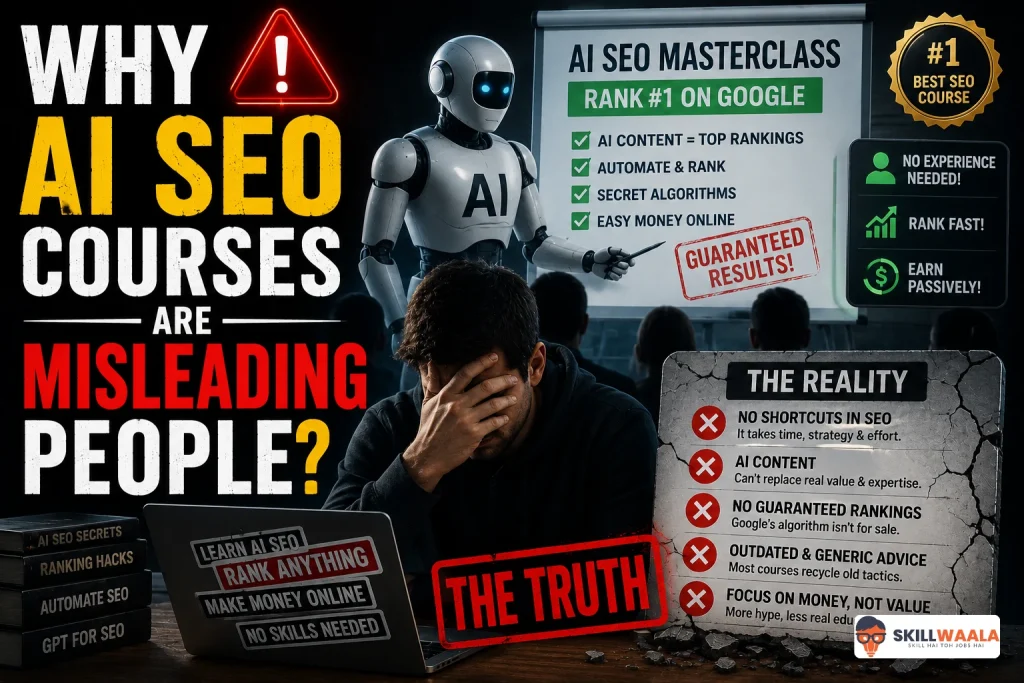
A lot of “AI SEO experts” appeared overnight. Some have never ranked a competitive website before. Harsh, but true. Most of these courses focus heavily on automation while ignoring the uncomfortable reality that SEO success still requires:
- Research
- Strategy
- Testing
- Patience
- User understanding
AI tools can absolutely improve workflows. We use them daily for outlines, SERP analysis, data sorting, and ideation. Still, tools are assistants. Not strategists. That distinction matters.
Ironically, one of the better learning approaches today is combining foundational SEO education with practical AI use rather than chasing shortcuts. Programs like the free AI tools course by Skillwaala are useful because they focus more on applying tools productively rather than selling fantasy ranking systems. That balance is healthier for long-term growth.
Google Is Preparing for Agentic AI Search
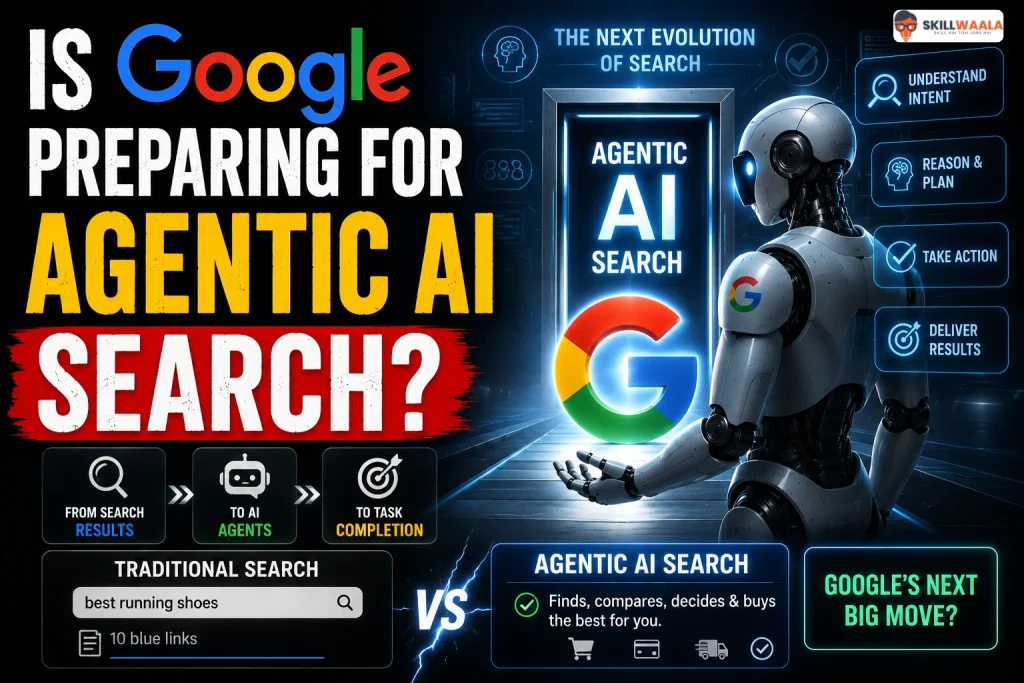
This part deserves more attention than it currently gets. Google hinted toward future AI systems interacting with websites more like autonomous agents rather than simple crawlers.
That means AI may eventually:
- Navigate interfaces
- Complete actions
- Read page layouts visually
- Understand workflows
- Interact with forms
Suddenly, usability becomes an SEO factor in a much deeper way. A confusing website structure will not just frustrate users anymore. It may confuse AI systems, too.
Websites with:
- clean architecture
- accessible navigation
- readable layouts
- structured information
will likely perform better over time. The future of SEO looks surprisingly human.
What Actually Works in SEO Right Now
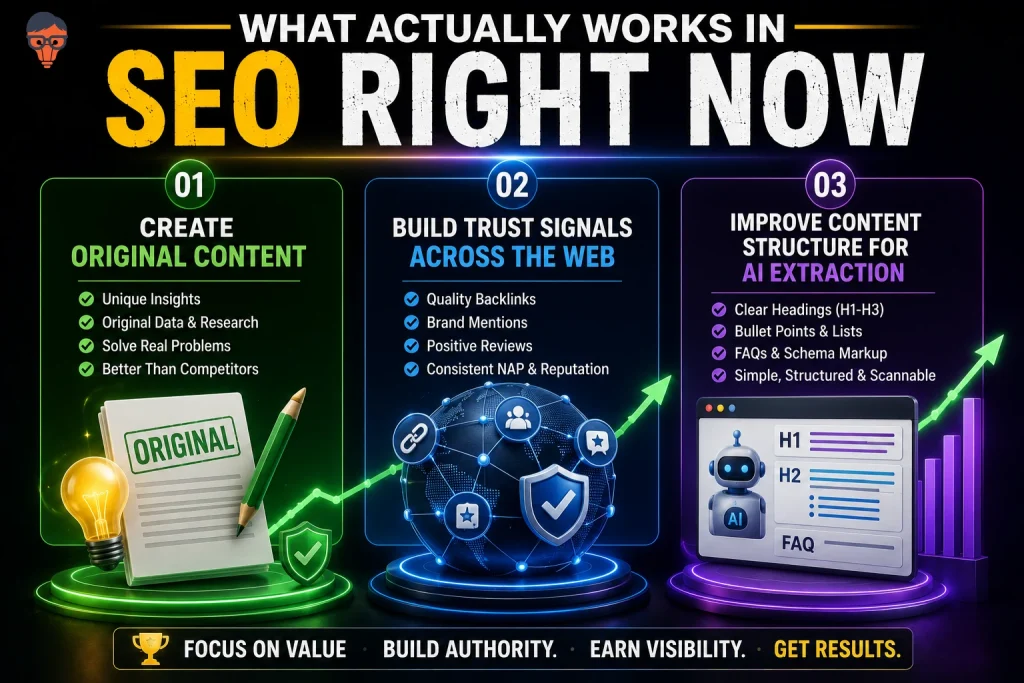
Forget the hype for a minute. Here are strategies consistently producing results across industries.
Create Original Content
Originality is becoming a ranking advantage again.
Simple additions improve trust dramatically:
- Personal insights
- Case studies
- Screenshots
- Industry observations
- Expert commentary
- Proprietary data
Even small original details separate useful content from generic AI summaries.
Build Trust Signals Across the Web
Google evaluates credibility beyond your website. Strong off-page signals still matter.
That includes:
- Brand mentions
- High quality backlinks
- Social visibility
- Professional profiles
- Industry citations
This is where resources like Best Profile Creation Websites for SEO still remain relevant. Properly optimized business profiles strengthen legitimacy and improve discoverability when done carefully. Spammy profile creation campaigns from 2014? Different story entirely.
Improve Content Structure for AI Extraction
AI-powered search experiences prefer clean, extractable information. Formatting matters more now.
Helpful formatting includes:
Structural elements AI systems prefer
- Descriptive headings
- Short paragraphs
- Tables
- Bullet lists
- Direct answers
- FAQ sections
Walls of text make extraction harder. Readable content performs better for humans, too, and funny how that keeps happening.
SEO Is Becoming Less About Tricks
The industry spent years chasing loopholes. Some still are. Yet Google’s recent messaging keeps pointing toward the same direction:
Create genuinely valuable websites and not perfect websites. Not “AI optimized” websites and valuable ones. That sounds almost disappointingly simple until you try doing it consistently.
Because consistency is where most websites collapse.
Final Thoughts
AI is changing search, no doubt about that. Content workflows are changing.
User behavior is changing. Search experiences are evolving rapidly. But the core principles behind visibility remain surprisingly stable.
- Useful content still wins.
- Strong technical foundations still matter.
- Trust still influences rankings.
- Original insights still separate leaders from noise.
The marketers who survive this shift will not be the ones generating the most content. They will be the ones creating the most believable, useful, experience-driven content on the internet.
Frequently Asked Questions
Yes. Google’s May 2026 guidance made it clear that AI Overviews, AEO (Answer Engine Optimization), and GEO (Generative Engine Optimization) still rely on the same foundational SEO principles like helpful content, crawlability, page structure, and trust signals rather than separate “AI ranking tricks.”
No. Google did not introduce any dedicated AI-ranking tags, hidden optimization frameworks, or “LLM SEO hacks.” Instead, Google emphasized creating useful, well-structured, user-focused content that search systems can easily understand and extract.
Many websites are publishing mass-produced AI content without adding originality, expertise, or real-world value. Google’s systems are increasingly better at detecting repetitive, low-value content that fails to satisfy users beyond surface-level information.
Traditional SEO fundamentals remain critical, including:
Strong technical SEO
Fast-loading pages
Clear heading structures
Internal linking
Mobile usability
Topical authority
Helpful content with real expertise
AI search systems still depend heavily on these signals to understand and trust websites.
Originality is becoming a major competitive advantage again. Content containing firsthand experience, screenshots, expert commentary, case studies, practical examples, and updated insights performs significantly better than generic AI summaries copied from existing web content.
Google’s AI systems prefer content that is easy to scan and extract. Clean formatting using descriptive headings, bullet points, concise paragraphs, FAQs, and direct answers improves readability for both users and AI-driven search experiences.
The biggest mistake is treating AI as a replacement for strategy and expertise. Google’s latest guidance strongly suggests that AI tools should support workflows like research, outlining, and analysis and not replace human insight, credibility, and genuinely useful content creation.
About The Author