
Artificial Intelligence is everywhere right now. You see it in search engines, writing apps, image creators, customer service bots, and even in your email inbox. It can feel overwhelming, like everyone else already knows how to use these tools, and you are just trying to catch up.
But here is the good news: learning AI tools is not as hard as it sounds. You do not need a tech degree or a coding background to get started. All you need is the right approach, time, and most importantly, the curiosity to explore.
This guide is for people just starting out. Whether you are a student, a working professional, a freelancer, or simply someone who wants to stay relevant in a fast-changing world, this blog will walk you through exactly how to begin.
How to Learn AI Tools?
The very first question most beginners ask is: Where do I even begin? The answer is simple. You start by using the tools, not just reading about them.
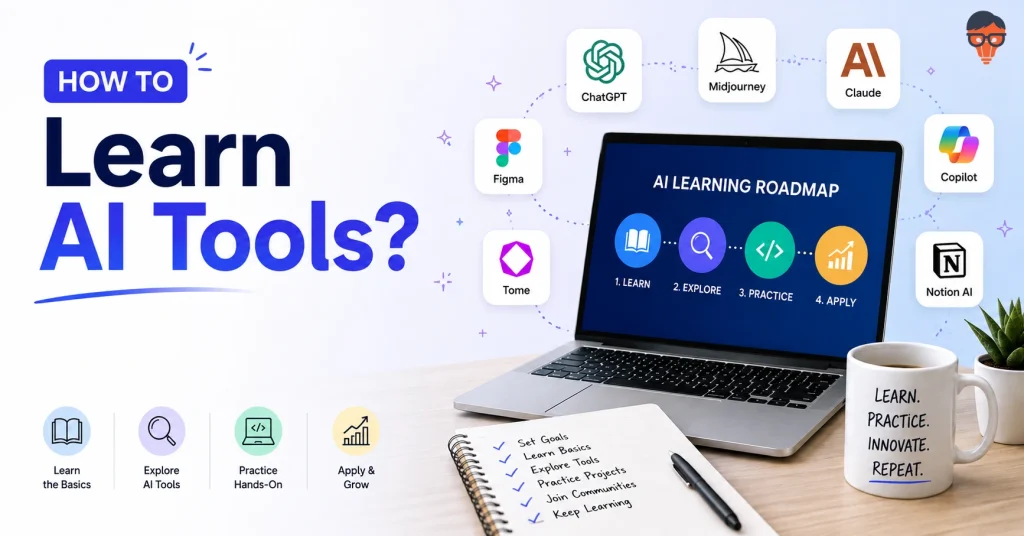
Too many people spend weeks watching videos and reading articles before they ever open a single AI tool. That approach slows you down, and the best way to learn is by doing, opening the tool, trying it, making mistakes, and learning as you go.
Here are some practical steps to help you start learning:
- Pick one AI tool and focus on it first, and do not try to learn ten tools at once.
- Set a small goal, for example, use ChatGPT to write a short email or summarize a paragraph.
- Spend at least 20 to 30 minutes with the tool each day to build the habit.
- Write down what works and what does not, as this will help you learn faster.
- Watch short YouTube tutorials when you get stuck on a specific task.
The key idea here is consistency, and you do not need to learn everything at once. Small, regular practice is far more effective than occasional long study sessions.
Also, do not be afraid to experiment. AI tools are designed to be forgiving, and you can ask the same question in ten different ways and see which one gives you the best result. That kind of exploration is how real learning happens.
AI Tools for Beginners
If you are new to AI, the number of tools out there can feel like a lot. But not all of them are meant for beginners, and you do not need to use them all. Here are some of the most beginner-friendly AI tools you can start with today:
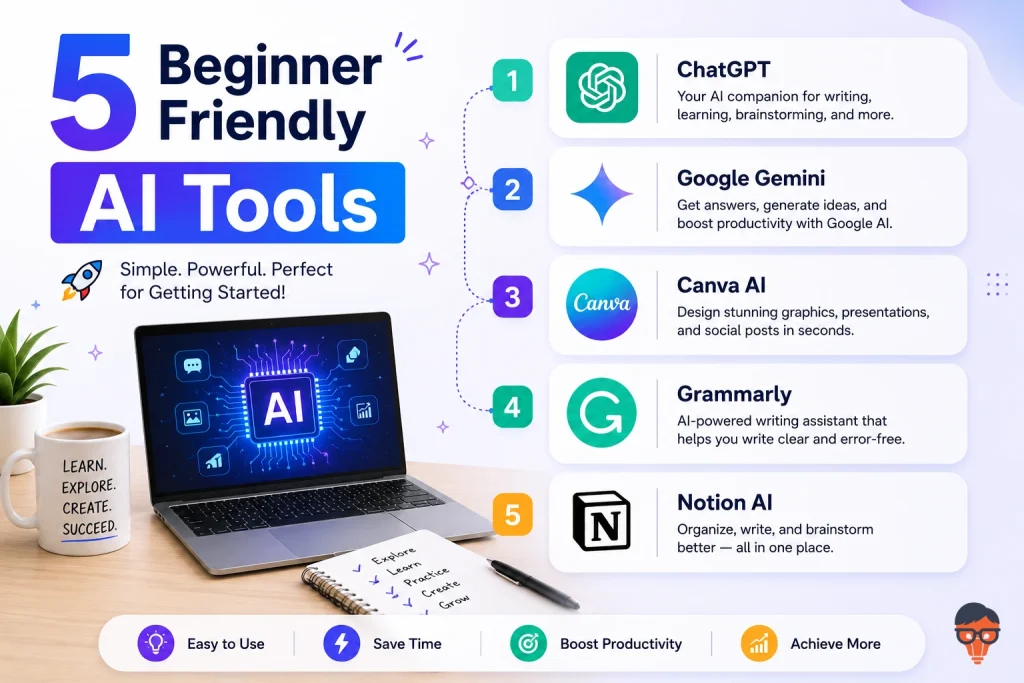
1. ChatGPT
This is probably the most well-known AI tool right now. You can use it to write content, answer questions, explain concepts, generate ideas, and much more. The interface is just a chat box: as you type, it responds. It is one of the easiest tools to pick up.
2. Google Gemini
Gemini is Google’s AI assistant and works similarly to ChatGPT. It is a great tool if you are already using Google products like Docs, Gmail, or Search. It is very user-friendly and integrates naturally into daily workflows.
3. Canva AI
If you want to create visuals without design skills, Canva’s AI features are perfect. You can generate images, design social media posts, and create presentations, all with simple text prompts.
4. Grammarly
Grammarly uses AI to improve your writing. It checks grammar, tone, clarity, and style. If you write emails, essays, or reports, this tool can save you a lot of time and make your writing look polished.
5. Notion AI
Notion AI helps you organize notes, summarize documents, write drafts, and manage your tasks. If you already use Notion, the AI features feel natural and easy to use.
When choosing a tool as a beginner, keep these tips in mind: start with tools that are free or have a free plan so there is no financial pressure, choose tools that connect to work you already do, writing, designing, organizing, and stick with one tool for at least two weeks before moving on to the next one.
Which AI Tool Is Better for Beginners?
Find out whether ChatGPT or Google Gemini is the better choice for learning, studying, research, and everyday productivity tasks.
Explore the ComparisonAI Tools Training
Once you have played around with a few tools, you might feel ready for something more structured. That is where AI tools training comes in. Training helps you move from casual use to confident, skilled use.
AI tools training does not always mean formal classes or certifications. It can be as simple as following a YouTube playlist or completing a few guided exercises online. What matters is that you are learning in a structured way.
- YouTube Tutorials offer free, high-quality content on almost every AI tool. Search for the name of any tool plus the word “tutorial,” or simply type ‘’free AI tools course’’ and you will find plenty of content.
- Official Help Docs and Guides are another excellent resource. Most AI tools have their own learning materials right on their website. OpenAI, Google, and other companies publish guides, FAQs, and video walkthroughs. These are often the most accurate and up-to-date sources.
- Practice Projects are one of the most effective forms of training. Give yourself a real task to complete using an AI tool. Use ChatGPT to plan a week-long travel itinerary, use Canva AI to design a simple logo for a fictional business, or use Notion AI to summarize a long article you saved. Completing real tasks builds skills much faster than just watching videos.
- AI Communities and Forums can also speed up your learning. Platforms like Reddit, LinkedIn groups, and Discord servers are full of people sharing tips and answers. You can ask questions without feeling judged, and you will often get helpful replies quickly.
AI Tools Course
If you want a more formal and structured way to learn, taking an AI tools course might be the right move for you. Courses are great because they give you a clear path from beginner to advanced, and many of them come with certificates that can boost your resume.
There are many options available online, some free, some paid, but not all of them are designed with beginners in mind. That is exactly where SkillWaala stands out.
SkillWaala’s online AI tools training is designed around real-world use. Instead of dry theory, you learn by working through hands-on tasks and projects that actually apply to everyday work. This is the kind of AI skills training that sticks because you are not just watching, you are doing.
The course covers the most in-demand tools being used by professionals today from AI writing assistants and image generators to automation tools and productivity apps. It is structured as a beginner AI course, but it takes you far enough that you finish feeling genuinely capable and confident.
Here is what makes SkillWaala’s AI course worth trying:
- It is completely free to join, no credit card, no hidden fees.
- The content is taught in simple, everyday language, perfect for non-technical learners, that too by industry experts.
- You get practical AI tools training with real examples, not just slides and lectures.
- The course is updated regularly to keep up with the fast pace of AI development.
- Upon completion, you earn a certificate that you can share on your resume or LinkedIn profile.
- Lastly, you get a guaranteed internship upon the successful completion of your course.
If you have been searching for the best free AI course for beginners or looking for AI tools training online that does not overwhelm you on day one, this is the place to start.

Final Thoughts
Learning AI tools is one of the most valuable things you can do for your career and daily life right now. The tools are becoming easier to use each month, and those who understand them will have a significant advantage in almost every field.
You do not need to become an AI expert overnight. Just pick one tool, practice it for a week, then add another. Take a short free course when you feel ready for structure, and even join a community to stay motivated.
Most importantly, do not let the fear of not knowing enough stop you from starting. Every expert was once a beginner, and the best time to start learning AI tools is right now.
Frequently Asked Questions (FAQs)
Yes! Most modern AI tools are built for everyday users, not just developers or data scientists. You don’t need coding or machine learning knowledge to use tools like ChatGPT, Canva AI, or Grammarly. A basic smartphone or computer skill is sufficient. Platforms like SkillWaala teach AI tools in simple, non-technical language for complete beginners.
You can become comfortable with basic AI tools in 2-4 weeks of practice for daily work. For proficiency across various tools, it may take 2-3 months of consistent effort.
Yes! Many free AI courses offer quality learning, especially for beginners. They focus on understanding basics, hands-on practice, and building confidence. SkillWaala’s free AI tools course emphasizes practical tasks over theory, making it highly effective for newcomers.
ChatGPT is widely recommended as the best starting point for most beginners. It is easy to access, free to use at a basic level, and flexible enough to support a variety of tasks, from writing and research to planning and brainstorming. Once you are comfortable with ChatGPT, you can explore more specialized tools depending on your needs, such as Canva AI for design or Grammarly for writing improvement.
Yes, and this is increasingly true each year. Employers in industries like marketing, finance, education, healthcare, design, and customer service seek candidates familiar with AI tools. Even basic AI skills, like content creation or data tasks, can distinguish you. An AI tools certificate from platforms such as SkillWaala shows employers you’re forward-thinking and prepared for the future of work.
About The Author