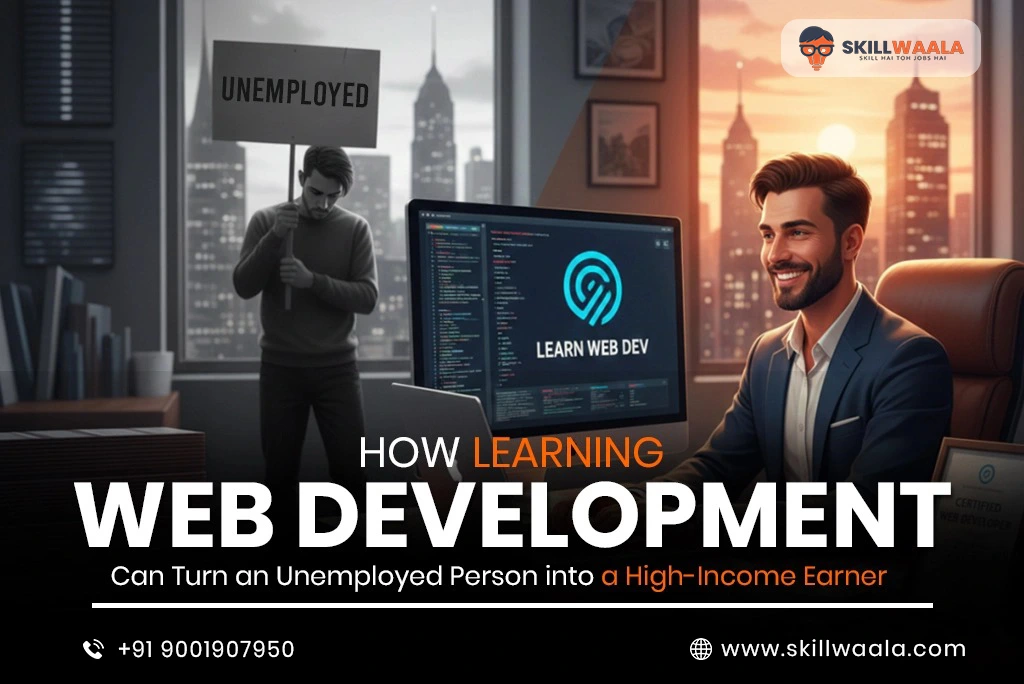
Look, we need to be honest with you about something. You know that sinking feeling when you send out your twentieth job application this month and hear nothing back? When relatives ask, “So, what are you doing these days?” and you avoid eye contact? While your friends and ex-colleagues post
We completely understand your frustrationt but trust us when we say that your current situation is not your final destination.
What if we told you that in the next eight to twelve months, you could go from unemployed to earning more than many of your degree-holding friends? What if there were a skill so in demand globally that companies were desperately hiring people regardless of their educational background? What if you could work from anywhere, for anyone, earning in dollars while living in India?
You guessed it right: that is a web development skill, and it is waiting for you to grab it!
Why Web Development Is Your Ticket to Financial Independence?
Every single website you visit, every app you use, and every online service you depend on, someone actually built that. Someone wrote the code from scratch that makes it work, and right now, there aren’t enough people to do this work to meet the massive global demand.
When we think about it, how many new websites launch every single day? How many businesses are desperately trying to get online? How many startups need developers? The numbers are unbelievably high, and each one of those needs represents a job opportunity, a freelance project, or a potential income stream for you.
Here is what makes web development special:
- Companies care about what you can build, not where you studied or what degree you have, making it perfect for people without traditional educational credentials who can demonstrate their skills through actual projects and portfolios.
- You can start earning within months of beginning your learning journey, not years, as traditional careers require, because businesses need working solutions immediately and will pay anyone who can deliver them reliably.
- The earning potential scales dramatically as you gain experience, with beginners making decent money and experienced developers commanding salaries that rival those of doctors and engineers, sometimes exceeding them by a significant margin.
- Location becomes irrelevant when you can work remotely for companies anywhere in the world, earning international rates while living in India, giving you purchasing power that transforms your entire family’s financial situation.
Related: Website Development Course Guide
Can I Become a Web Developer Without a Degree?
Of course! This question haunts so many talented people, and they think that because they could not complete their engineering degree or never attended college, coding is impossible for them.
Some of the most successful developers we know personally are college dropouts, twelfth-pass students, or even people who studied subjects completely unrelated to their current work, like commerce or arts.
What got them hired was not their degree certificate, but it was their GitHub portfolio showing real projects they built. It was their ability to solve problems and their hunger to learn and grow.
Why does web development not require a degree?
- Coding is a skill you learn by doing, not by memorizing textbooks. This means your education happens through building actual projects that demonstrate capability rather than through academic credentials.
- Employers test you through practical assessments where you build features or fix bugs, proving your competence in real-time rather than relying on certificates that might not reflect actual ability.
- Your portfolio speaks louder than any degree could, showcasing live websites you have created, problems you have solved, and the quality of your code for anyone to inspect and evaluate.
- Numerous free and affordable online resources teach you everything that top universities focus on. Like SkillWaala’s free web development course, where you can learn all the skills required to become a skilled web developer in 4 to 6 months.
What is Frontend and Backend?
Web development has two main paths, and understanding both helps you make smart career decisions:
Frontend Development
Frontend is everything users see and interact with on websites – the buttons they click, the forms they fill out, the animations that play, and the layouts that make browsing smooth. Frontend developers use languages like HTML for structure, CSS for styling, and JavaScript for interactivity.
Backend Development
The backend is the invisible engine that powers everything behind the scenes, from databases storing user information to servers processing requests, authentication systems keeping accounts secure, and APIs connecting different services. Backend developers use languages such as Python, Node.js, Java, and PHP.
| Aspect | Frontend Development | Backend Development |
| What You Build | User interfaces, visual design | Databases, server logic |
| Main Languages | HTML, CSS, JavaScript | Python, Node.js, Java |
| Learning Curve | Gentler for beginners | Steeper initial learning |
| Average Starting Salary | ₹25,000-40,000/month | ₹30,000-50,000/month |
| Freelance Opportunities | Abundant, easier to start | Fewer but higher-paying |
Full Stack Development
It means mastering both frontend and backend, making you incredibly valuable because you can build complete applications independently without needing separate specialists for different parts.
The best free full-stack developer course for beginners systematically covers both paths, starting with frontend fundamentals, progressing to backend complexity, and integrating it all through real projects.
Related: Trending Front-End Web Developer Skills
How to Get a Web Developer Job Without a Degree?
Getting hired as a web developer without traditional credentials requires a strategic approach, but thousands have done it successfully, and you can too.
Step One: Build Your Portfolio Strategically
Create five to seven impressive projects that showcase different skills rather than building twenty mediocre ones that fail to impress anyone, focusing on quality over quantity and including live links where recruiters can interact with your work, see your code on GitHub, and understand your problem-solving approach through detailed README files explaining your thought process.
Step Two: Contribute to Open Source Projects
Join existing projects on platforms like GitHub where developers worldwide collaborate on software, starting with small contributions like fixing documentation errors or minor bugs, gradually tackling bigger features as your confidence grows, because these contributions serve as proof of your ability to work with real codebases and professional development workflows.
Step Three: Network Actively in Developer Communities
Join online communities on platforms like Twitter, LinkedIn, Discord, and Reddit where developers hang out, share your learning journey publicly, ask thoughtful questions, help other beginners when you can, and build genuine relationships rather than just collecting contacts, because many jobs come through referrals from people who have seen your work and attitude.
Step Four: Apply Strategically and Persistently
Target companies that value skills over degrees, especially startups and digital agencies that care more about what you can deliver than your educational background, customize each application showing you researched the company and understand their needs, include your portfolio prominently, and prepare thoroughly for technical interviews by practicing common coding challenges.
The trainers are industry experts who share years of experience from different fields with the students in real time to help them understand the concept easily, which accelerates your learning curve dramatically because you learn not just syntax and theory but actual industry practices, common mistakes to avoid, and insider knowledge about what employers really look for.
Web Developer Salary in India: Real Numbers You Should Know
Let me give you realistic salary expectations so you can plan your financial journey properly:
Entry-level web developers
Focusing on three to six months of solid learning and a decent portfolio typically earns 25,000 to 40,000 rupees monthly as a full-time employee, which might seem okayish, but remember this is just your starting point with massive growth potential ahead.
Mid-level developers
With one to three years of experience and specialized skills, command salaries ranging from fifty thousand to ninety thousand rupees monthly, especially if they have expertise in in-demand frameworks like React, Angular, or Node.js that companies desperately need.
Senior developers
Gaining four-plus years of experience and a proven track record of building complex applications, one can earn anywhere from one lakh to three lakh rupees monthly. Sometimes even more if they work for well-funded startups or multinational companies.
Freelance web developers
Being a freelance web developer has unlimited earning potential because they can serve multiple clients simultaneously, charge project-based rates rather than monthly salaries, and work with international clients who pay significantly higher rates than Indian companies typically offer.
How to Earn Money by Web Development? A Roadmap
Let me map out what your earning journey might realistically look like:
Months 1-3
Intensive learning phase with zero income but crucial foundation building through web development course for beginners that covers HTML, CSS, JavaScript fundamentals, and basic projects, investing time now to earn later rather than looking for shortcuts.
Months 4-6
Start taking small freelance projects or unpaid internships that build your portfolio with real work experience, possibly earning five thousand to fifteen thousand rupees monthly while continuing to learn advanced topics and improve your skills consistently.
Months 7-9
Land your first proper job or establish freelance clients earning twenty-five thousand to forty thousand rupees monthly, finally seeing real financial returns on your learning investment and gaining confidence in your abilities.
Months 10-12
With solid experience now, either get promoted or switch to better-paying opportunities, and negotiate higher freelance rates based on proven results, potentially earning 45,000 to 70,000 rupees monthly.
Beyond Year One
Specialize in high-demand areas, become a full-stack developer, take on complex projects, and watch your income grow to six figures monthly as you become an expert whom companies compete to hire.
This timeline assumes consistent effort and smart learning. The trainers are industry experts who share years of experience from diverse fields with students in real time, helping them understand concepts more easily and avoiding common beginner mistakes from the start.
One Last Thing
Start with a web development course for beginners that properly teaches the fundamentals. Commit to studying two to three hours daily without excuses. Build projects constantly, even ugly ones, because every line of code you write makes you better. Share your learning journey publicly to build accountability and connections.
Remember, every expert developer you admire online was once exactly where you are now – unemployed, uncertain, scared, wondering if they could really do this. The only difference between them and you is that they started. They persisted. They refused to give up when things got hard.
Web development does not require genius-level intelligence or special talent. It requires consistency, a problem-solving attitude, and a willingness to embrace discomfort as you learn. Those are choices, not gifts.
Frequently Asked Questions (FAQs)
With focused, consistent effort, studying two to three hours daily, most people become job-ready in six to nine months. This timeline includes learning frontend fundamentals like HTML, CSS, and JavaScript, building a portfolio with five to seven solid projects, understanding basic backend concepts, and practicing technical interview questions
Absolutely yes. Every single web developer started with zero coding knowledge at some point. Modern web development courses designed for complete beginners start with the absolute basics, assuming no prior technical background whatsoever.
Entry-level developers without degrees but with strong portfolios typically earn 25,000 to 40,000 rupees per month, which is comparable to, and sometimes better than, many traditional jobs that require degrees. Within one to two years of experience, this can grow to 50,000 to 80,000 rupees per month. Senior developers with 3+ years of proven expertise can command 1 lakh to 2 lakh 50 thousand rupees per month, regardless of educational background.
Start by offering free services to one or two small businesses or nonprofits to build your initial portfolio and get testimonials, then use those projects as proof when approaching paid opportunities. Within three to four months of learning, you can take small freelance projects on platforms like Fiverr or Upwork for reduced rates to gain experience and reviews.
Frontend development generally has a gentler learning curve for complete beginners because you can see immediate visual results of your code, making it more rewarding and easier to debug. Backend development requires understanding more advanced concepts, such as databases, servers, and APIs, which can be harder to grasp initially. However, becoming a full-stack developer who knows both frontend and backend makes you significantly more valuable and employable because you can build complete applications independently.
Many job postings list degree requirements as a default filter, but companies routinely hire candidates without degrees if their portfolio and skills are strong enough. Apply anyway with a compelling portfolio that showcases real projects solving actual problems, a GitHub account demonstrating clean code and consistent contributions, and a cover letter specifically addressing how your skills match their needs despite lacking formal education. Target startups and digital agencies that value practical skills over credentials. Many companies care far more about what you can build than where you studied.
Start with free resources like freeCodeCamp, The Odin Project, or MDN Web Docs to learn the fundamentals of HTML, CSS, and JavaScript without spending any money. YouTube channels and institutes like Traversy Media, Net Ninja, and SkillWaala offer excellent free tutorials. When choosing paid options, look for transparent pricing – Skillwaala offers a written guarantee that all its courses and additional benefits are free, with no hidden charges, making quality education accessible regardless of financial background.
About The Author